


Drinkware Industry Insights
The Science of 24H Thermal Retention: Why Copper Plating Matters in Vacuum Bottles

The Science of Thermal Retention: Why Copper Plating Matters in Vacuum Bottles
Why can some vacuum bottles keep ice frozen for 24 hours, while others lose temperature overnight?
For B2B buyers and private-label brands, the difference between a premium vacuum flask and a low-performance product often comes down to one invisible but critical technology: copper plating.
Understanding how copper plating works—and why it matters—helps you make better sourcing decisions and deliver a clearly superior user experience.
How Vacuum Insulation Actually Works
A stainless steel vacuum bottle is built with two walls:
- An inner wall that holds the beverage
- An outer wall that stays cool to the touch
The air between these two walls is evacuated to create a vacuum layer.
Why the Vacuum Matters
A vacuum blocks heat transfer through:
- Conduction (direct contact)
- Convection (air movement)
This is why vacuum insulation is far more effective than single-wall or foam-insulated bottles.
However, there is still one remaining path for heat loss: thermal radiation.
The Hidden Problem: Radiant Heat Loss
Even in a perfect vacuum, heat can escape in the form of infrared radiation.
Without additional treatment, this radiant energy slowly leaks through the bottle walls—reducing temperature retention over time.
This is where copper plating becomes essential.
Copper Plating: The High-Performance Solution
In premium vacuum bottle manufacturing, the outer surface of the inner wall is coated with a thin layer of copper through an electroplating process.
Why Copper Works
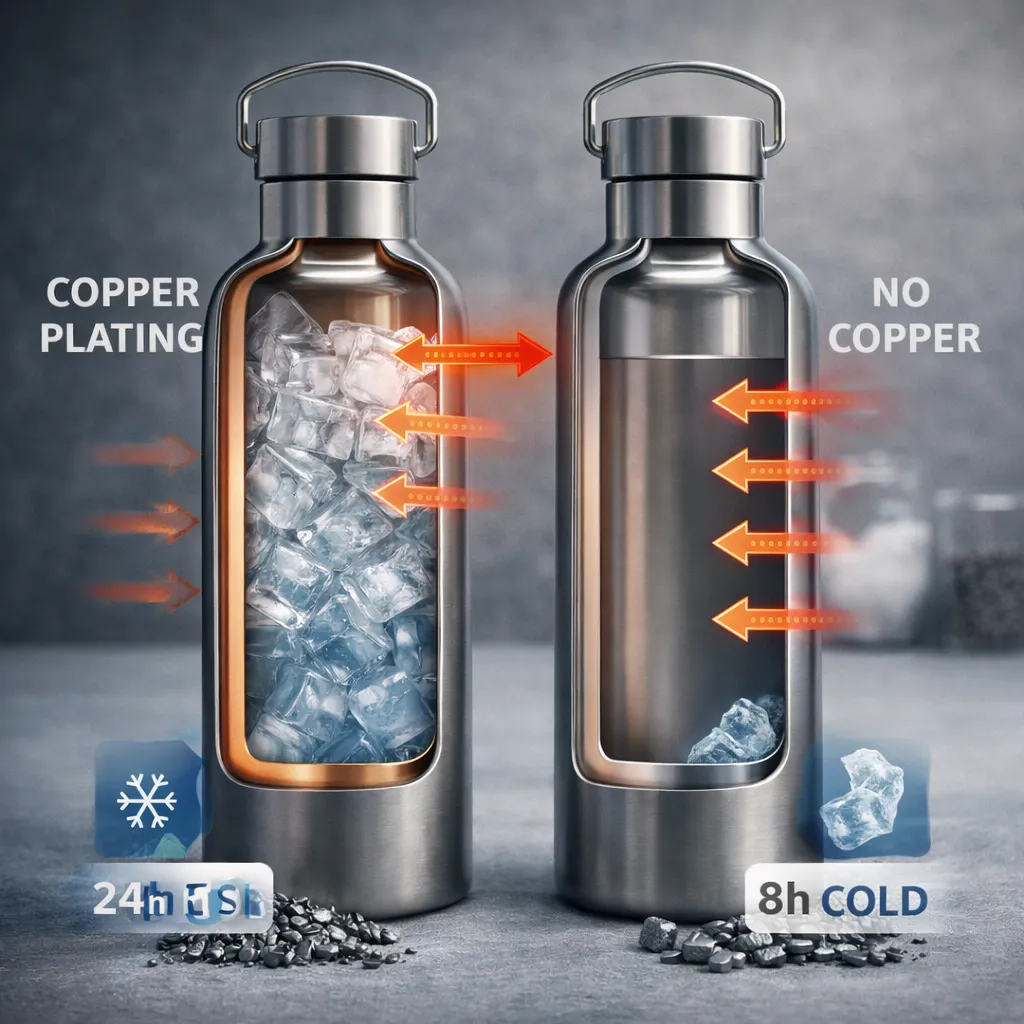
Copper has exceptionally high reflectivity for infrared radiation.
- For hot beverages: radiant heat is reflected back into the liquid
- For cold beverages: external heat is reflected away from the contents
In simple terms, copper acts like a thermal mirror, dramatically slowing temperature loss.
Performance Difference: With vs. Without Copper Plating
The impact of copper lining is significant and measurable:
- Copper-plated vacuum bottles:
- Maintain temperature for 12–24 hours
- Standard vacuum bottles (no copper):
- Typically last only 6–8 hours
For end users, this difference is immediately noticeable—and directly affects product reviews, repeat purchases, and brand reputation.
How to Verify Quality When Auditing a Supplier
Copper plating is invisible from the outside, so documentation matters.
What to Ask Your Supplier For:
- A thermal retention test report
- Clear confirmation of “Vacuum Insulation with Copper Lining”
Industry Reference Benchmark
A high-quality 500 ml copper-plated vacuum bottle should:
- Start at 95°C
- Maintain above 60°C after 6 hours
If a supplier cannot meet or document this standard, the product is unlikely to perform at a premium level.
Key Takeaway for B2B Buyers
Copper plating is an “invisible specification”, but it plays a decisive role in user experience and perceived quality.
When sourcing stainless steel vacuum bottles, always specify:
Vacuum Insulation with Copper Lining
This ensures:
- Consistent thermal performance
- Clear product differentiation
- Fewer customer complaints and returns
In competitive drinkware markets, copper plating is not a luxury—it’s a defining feature of high-performance vacuum insulation.