

Drinkware Industry Insights
304 vs. 316 Stainless Steel Water Bottles: A B2B Guide to Material Selection & Cost

304 vs 316 Stainless Steel: Which Grade Should Your Brand Choose?
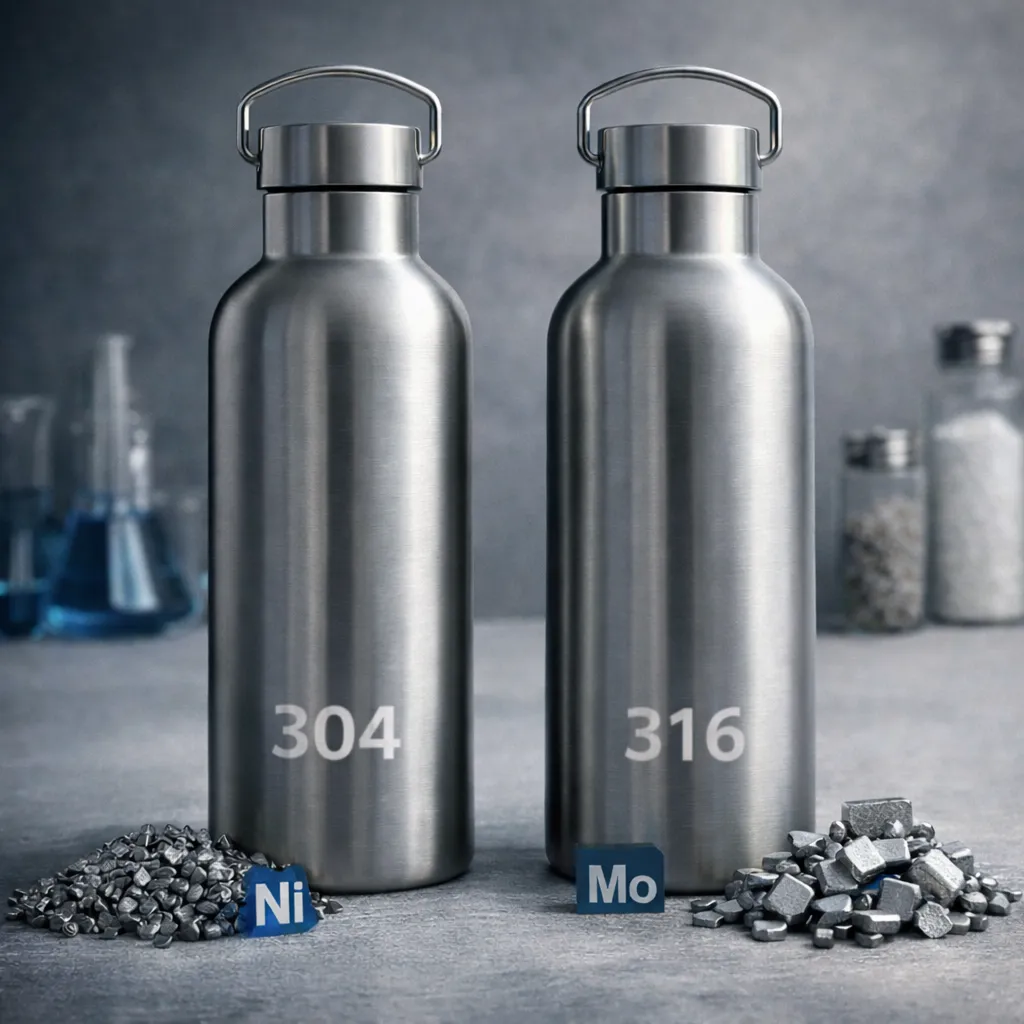
When sourcing stainless steel water bottles or vacuum insulated drinkware, one of the first and most important technical decisions is material selection: 304 (18/8) or 316 (18/10) stainless steel.
Although these two grades look identical to the naked eye, their chemical composition directly affects corrosion resistance, long-term safety, product cost, and brand positioning—especially for B2B buyers, importers, and private label brands.
Understanding this difference helps you avoid overpaying for unnecessary specifications—or worse, under-specifying materials that could harm your brand reputation.
The Chemistry Behind 304 vs 316 Stainless Steel
Both 304 and 316 belong to the austenitic stainless steel family, widely used in food-contact products due to excellent formability and corrosion resistance.
304 Stainless Steel (18/8)
- Composition: 18% Chromium, 8% Nickel
- Industry Standard: The most commonly used material for high-quality drinkware
- Performance: Excellent resistance to rust and oxidation when exposed to water, coffee, tea, and most daily beverages
304 stainless steel is FDA- and LFGB-compliant when properly manufactured and remains the gold standard for mainstream water bottles, tumblers, and vacuum flasks.
316 Stainless Steel (18/10)
- Composition: 18% Chromium, 10% Nickel + ~2% Molybdenum
- Key Upgrade: The addition of molybdenum, which dramatically improves resistance to pitting corrosion
This enhancement makes 316 stainless steel significantly more resistant to chlorides (salt), acids, and aggressive cleaning cycles, outperforming 304 in harsh environments.
Corrosion Resistance: Does 316 Really Perform Better?
Yes—but context matters.
- In normal daily use, 304 stainless steel performs exceptionally well and shows no practical disadvantage.
- In high-salt, acidic, or sterilization-heavy environments, 316 offers superior long-term durability.
For most consumer drinkware applications, corrosion resistance is not the limiting factor—product design, vacuum insulation quality, and sealing technology usually matter more.
Cost Comparison: 304 vs 316 Stainless Steel
For B2B buyers, material cost has a direct impact on pricing strategy and margins.
- 316 stainless steel typically costs 20–40% more than 304
- Price difference is driven by:
- Higher nickel content
- Addition of molybdenum
Cost-Saving Recommendation
If you are targeting:
- Mass retail markets
- Promotional drinkware
- Amazon or private label brands
👉 304 stainless steel delivers the best balance of performance, safety, and cost efficiency.
Best Use Cases for Each Grade
Choose 304 Stainless Steel For:
- Daily hydration bottles
- Coffee tumblers and travel mugs
- Corporate gifts and promotional giveaways
- Most vacuum insulated drinkware
304 stainless steel is safe, durable, and trusted by over 90% of global drinkware brands.
Choose 316 Stainless Steel For:
- Baby bottles and infant products (frequent sterilization)
- Marine or outdoor drinkware exposed to saltwater
- Protein shakers or acidic beverages (fruit juices, supplements)
In these scenarios, 316 offers an extra layer of protection against metal ion migration over years of use.
304 vs 316: Marketing & Brand Positioning
Beyond performance, material choice also influences brand perception.
- 304 Stainless Steel: Trusted, proven, industry-standard
- 316 Stainless Steel: Premium, medical-grade, ultra-high-end positioning
If your brand emphasizes “medical grade,” “ultra-premium,” or “professional use”, upgrading to 316 can serve as a powerful marketing differentiator.
Final Verdict for B2B Buyers
Don’t overpay for specifications you don’t need—but never compromise on safety.
- For 90% of water bottle brands, 304 stainless steel is the optimal choice.
- For specialized, high-end, or extreme-use products, 316 stainless steel justifies its higher cost.
B2B Tip
Always request material certification and spectral analysis reports from your supplier to confirm the inner wall is genuine 304 or 316 stainless steel.
👉 Looking for compliant, vacuum insulated stainless steel water bottles? Contact our engineering team for material samples and test reports.